


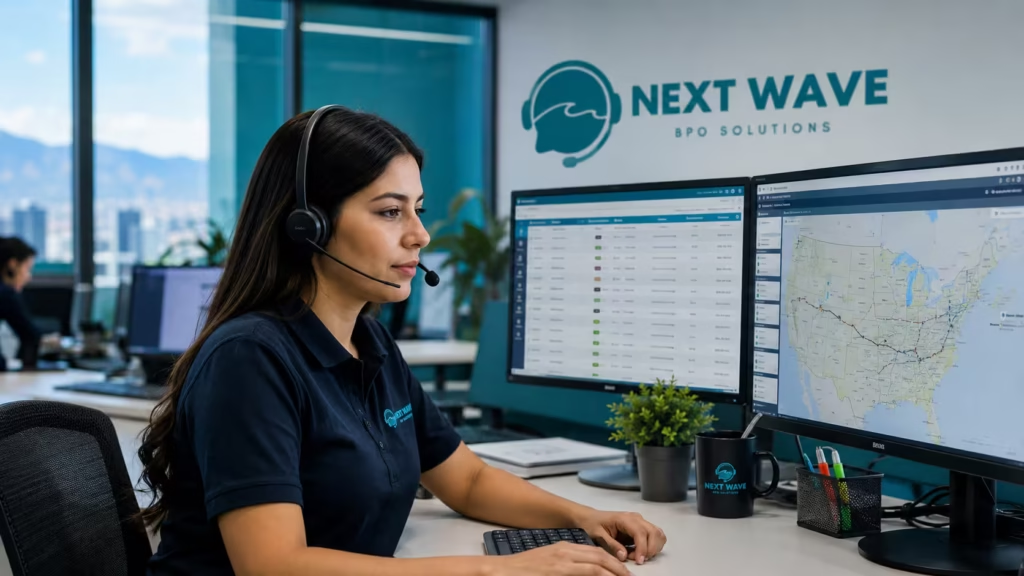
Dispatch outsourcing Colombia is quickly becoming one of the most effective operational decisions U.S. trucking companies are making — and most of them aren’t talking about it publicly. For years, fleet owners believed that growing a dispatch operation meant hiring more people domestically or accepting the limitations of an overloaded team. Today, a third option is reshaping how fleets of every size handle coordination, coverage, and back-office load.
This shift is not driven by desperation. Instead, it is driven by strategy. Companies making this move are thinking ahead — and the results are changing how they compete.
The moment dispatch stops working
Most trucking companies don’t realize they have a dispatch problem until the operation starts feeling heavier than the freight itself. At first, everything works — a few trucks, a manageable number of drivers, phones ringing, loads moving, paperwork done by end of day.
Then growth happens. And suddenly dispatch stops being coordination and starts becoming survival. The warning signs are always the same:
- Drivers calling at midnight with no consistent coverage
- Brokers expecting replies in under five minutes — or moving the load
- Load updates that don’t stop, even on weekends and holidays
- One missed check call turning into a delayed pickup, an unhappy customer, and a fire that needs immediate attention
- Owners buried in daily operations instead of building the business
Usually, the problem isn’t the people — it’s the structure. A dispatch model built for five trucks doesn’t scale to twenty without something breaking. And what breaks first is always the team carrying the load.
Why traditional dispatch models break under pressure
Dispatch is one of the most operationally intensive functions in trucking. It demands constant availability, fast decision-making, strong broker relationships, and precise documentation — all at the same time, every day. Even strong in-house teams eventually hit a ceiling when volume grows faster than their capacity.
When that ceiling is reached, a predictable chain reaction follows:
- Dispatchers become overloaded
- Response times slow down
- Mistakes increase and driver frustration grows
- Brokers lose confidence and move freight elsewhere
- Revenue per mile drops without anyone changing rates
- The owner spends more time firefighting than growing the business
What companies across the U.S. are discovering is that the root issue is not talent — it is capacity. Furthermore, capacity problems are solved with the right support structure, not by asking the same team to do more with less.
What dispatch outsourcing to Colombia actually looks like
For many fleet owners, “outsourcing” still carries outdated associations — distant call centers, disconnected teams, agents who have never seen a load board. However, dispatch outsourcing in Colombia looks nothing like that.
In practice, it means bilingual dispatch coordinators and back-office support professionals based in Colombia, integrated directly into an existing operation. These coordinators work U.S. hours, use the same systems, communicate directly with drivers and brokers, and handle the operational volume that is currently slowing the in-house team down.
As a result, they are not replacing the internal team — they are giving it breathing room. That difference matters more than most owners expect.
The tasks Colombian dispatch teams handle every day
One of the most common questions fleet owners ask is: what exactly will a nearshore dispatch team handle? Here is a representative breakdown of the daily tasks managed by Colombian logistics support teams working with U.S. carriers:
Load management
- Load board monitoring across DAT, Truckstop, and direct broker contacts
- Rate negotiation and load confirmation
- Rate confirmation review, filing, and broker follow-up
Driver and fleet coordination
- Check calls and real-time ETA updates
- After-hours driver communication and support
- Appointment scheduling, rescheduling, and breakdown coordination
Back-office and documentation
- BOL management, detention documentation, and TONU tracking
- Delivery confirmation follow-up and invoicing preparation
- Broker communication, status updates, and issue escalation
In total, these tasks represent the core operational volume that consumes 60 to 70 percent of a dispatcher’s working day — work that a well-trained nearshore team can absorb while the in-house staff focuses on high-value decisions and relationships.
Why Colombia — not just any nearshore market
Several countries offer nearshore staffing for U.S. companies. Nevertheless, Colombia has emerged as one of the strongest destinations — and for reasons that go well beyond labor cost.
Over the last several years, Colombia has developed a deep workforce of bilingual professionals with direct experience supporting U.S. companies in logistics, freight, customer service, and back-office operations. This is not generalist talent being trained from scratch — rather, it is an industry-relevant workforce that already understands the context of U.S. trucking.
- Full time zone alignment with U.S. Eastern and Central business hours
- High English proficiency with industry-specific freight vocabulary
- Cultural compatibility with U.S. business communication standards
- Strong technology infrastructure in cities like Medellín and Bogotá
- Significant cost advantage compared to equivalent U.S. hires — without quality tradeoffs
- Growing freight-specific talent pool with TMS and load board experience
For smaller fleets especially, this combination changes the math entirely. Hiring an additional full-time dispatcher in the U.S. can represent a $50,000 to $65,000 annual commitment before benefits. Therefore, building nearshore operational support feels — and costs — like a scalable infrastructure investment, not a fixed headcount decision.
Real cost comparison: in-house dispatch vs. nearshore support
Understanding the financial case for dispatch outsourcing in Colombia requires looking at total cost of employment — not just base salary.
| Cost component | In-house (U.S.) — annual | Nearshore Colombia — annual |
|---|---|---|
| Base salary | $45,000 – $60,000 | Included in staffing |
| Payroll taxes & benefits | $10,000 – $15,000 | Managed by staffing partner |
| Recruitment & onboarding | $3,000 – $8,000 | Managed by staffing partner |
| Total estimated annual cost | $60,000 – $88,000 | $18,000 – $28,000 |
With a cost differential ranging from 50 to 70 percent in savings, operational capability stays intact. Additionally, for fleets adding two or three support roles, that saving compounds significantly across the year.
Common concerns about outsourcing dispatch — and honest answers
Will they understand the trucking industry?
Yes — when working with a staffing partner that specializes in logistics talent. Colombian dispatch professionals with U.S. freight experience already know load boards, TMS platforms, broker workflows, and industry terminology. As a result, the learning curve is shorter than hiring a domestic candidate with no trucking background.
What about communication quality?
Bilingual dispatch coordinators in Colombia are trained specifically for U.S. business communication. English proficiency, professional phone etiquette, and written communication standards are core to the profile — not an afterthought.
Can they work our hours?
Absolutely. Colombia’s time zone aligns fully with U.S. Eastern and Central business hours, and support can be structured for after-hours and weekend coverage as well.
Will we lose control of our operation?
Not at all. Designed to extend capacity rather than replace oversight, this model keeps the company in full control of load approvals, carrier relationships, and strategic decisions. Moreover, the nearshore team handles execution within the same SOPs as the in-house staff.
Which fleets benefit most from this model
Dispatch outsourcing in Colombia is not reserved for large carriers. In fact, smaller and mid-size fleets often see the most immediate and measurable impact.
- Owner-operators and small fleets (1–10 trucks) get dedicated dispatch support without the overhead of a full-time U.S. hire — staying on the road while a professional handles broker communication and load management.
- Growing fleets (10–50 trucks) gain the scalability to add dispatch capacity as the fleet grows, without the recruiting cycles and fixed costs of expanding in-house headcount.
- Established carriers benefit from after-hours coverage, overflow support during peak periods, and back-office functions that free senior dispatchers for relationship management and strategic planning.
Across every profile, the common thread is the same: operational pressure that grows faster than the current structure can absorb. Nevertheless, nearshore support changes that equation entirely.
How to get started without disrupting your operation
Transitioning to nearshore dispatch support does not require rebuilding the operation. A well-structured onboarding process follows a clear and proven sequence:
- Discovery call — define lanes, volume, software stack, and key pain points
- Role scoping — identify which tasks will be handled nearshore vs. retained in-house
- Candidate vetting and presentation — typically within 5 to 7 business days from the initial brief
- Integration and onboarding — system access, SOPs, and communication protocols aligned
- Go-live and ramp — most teams are fully operational within the first two weeks
Working with a staffing partner that understands U.S. freight operations specifically is essential — not a generalist BPO staffing logistics roles with agents who have never seen a load board.
Build your nearshore dispatch team with NextWave BPO
NextWave BPO connects U.S. trucking companies with experienced, bilingual dispatch coordinators and logistics support professionals based in Colombia. Built specifically for the freight industry, this model places talent that already understands TMS platforms, load boards, broker communication, and the pace of U.S. trucking operations.
- Bilingual dispatch coordinators with direct U.S. freight experience
- Back-office logistics support — documentation, check calls, broker communication
- Fast placement — candidates presented within 5 to 7 business days
- Full time zone coverage aligned with U.S. operations
- Transparent, cost-effective pricing with no hidden fees
Competition in the industry is intensifying. As a result, margins are tighter and customers expect faster communication. Furthermore, drivers expect better coordination and operational efficiency is no longer optional. Therefore, fleets adapting early are building systems that can grow without collapsing under their own weight — and increasingly, those systems include nearshore dispatch teams in Colombia. Quietly, efficiently, and far more often than most people realize.
