


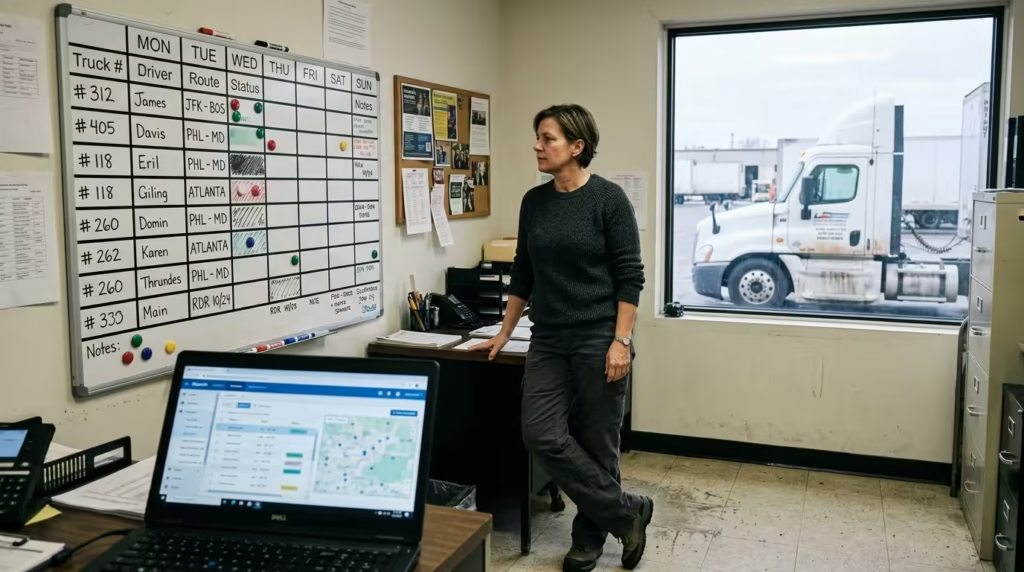

There comes a point in the growth of almost every fleet when dispatch becomes a bigger question than simply who is going to answer the phone. Maybe the owner has been dispatching trucks personally and can no longer keep up. Maybe an existing dispatcher is spending half the day tracking loads, answering brokers and handling paperwork instead of planning the operation. Or perhaps the fleet is adding trucks and realizes that the system that worked with five drivers may not work with fifteen.
At that point, the question usually becomes: should we hire another dispatcher in-house, or should we outsource the position? There isn’t one answer that works for every fleet. The right model depends on what your operation needs, how much control you want to maintain, what your current team is already handling and, perhaps most importantly, what problem you’re actually trying to solve.
When In-House Dispatch Makes Sense
There are good reasons trucking companies build their own dispatch departments. Having someone inside the company can make sense when the role requires constant interaction with other departments, significant authority over operational decisions or deep knowledge that has developed inside the organization over years.
For some fleets, that proximity matters. An experienced internal dispatcher may know each driver’s preferences, understand the nuances of particular customers and lanes, recognize recurring problems before anyone mentions them and participate directly in broader operational decisions.
If your dispatch structure is working well, your team has enough capacity and the cost of maintaining it makes sense for the business, outsourcing simply because it’s available isn’t necessarily an improvement. The problem usually begins when the fleet grows faster than the dispatch structure around it.
One Dispatcher Can Quietly Become Five Different Jobs
Dispatch rarely stays limited to dispatch. The same person who is planning loads may also be checking truck locations, answering broker emails, confirming appointments, following up with drivers, updating customers, collecting PODs and BOLs, entering information into systems and dealing with whatever unexpected problem appeared ten minutes ago.
None of those responsibilities seem unreasonable on their own. Together, they can consume an entire day. That’s when fleets sometimes assume they need another full in-house dispatcher when what they actually need is additional operational capacity. And those are not always the same thing.
Before choosing a model, look at where your current team’s time is going. If your best dispatcher is spending hours performing routine tracking and administrative follow-up, hiring another person to repeat the same structure may solve the immediate workload problem without solving the underlying one.
Outsourcing Doesn’t Have to Mean Giving Away Your Dispatch Operation
This is where the word “outsourcing” can create the wrong impression. Some fleet owners hear it and imagine handing their trucks to an external dispatch company that makes decisions independently, works with multiple carriers and sits somewhere outside the operation. That’s one model. It isn’t the only one.
A dedicated nearshore staffing model works differently. Instead of outsourcing control of dispatch, a fleet can add professionals who work specifically within its operation. They can use the company’s systems, follow its processes, work during the required U.S. hours and report to the people the fleet chooses.
The fleet keeps control. What changes is where the additional team member is located and how the position is staffed. For a company that wants more capacity without building every position locally in the United States, that distinction is important.
The Real Comparison Is Control, Capacity and Cost
Cost inevitably enters this conversation, but it shouldn’t be the only consideration. An in-house employee comes with the advantage of physical proximity when the company operates from an office. Depending on the role, that can be valuable. It also comes with the full cost of recruiting and employing another person domestically, along with the time required to find someone who understands the industry.
Traditional outsourced dispatch may reduce some of that burden, but the carrier may have less influence over who is doing the work or how the external provider organizes its team. Dedicated nearshore staffing sits somewhere between those models: the professional is recruited specifically for the position and works as part of the client’s operation, while the staffing partner handles the employment structure in the country where that person is based.
For many fleets, the question therefore isn’t simply “in-house or outsourced?” It’s: how much control do we want to keep, and which parts of staffing do we actually need someone else to handle?
Think About the Hours Your Operation Really Needs
Trucking doesn’t stop neatly at 5 p.m. A truck can still be moving after the office closes. A broker may need an update. A delivery appointment can happen early in the morning. A delay at a facility can push a problem into the evening.
Building that coverage entirely in-house can require additional shifts or employees, particularly as a fleet grows. This is one area where nearshore teams can become useful. Professionals in Colombia can work aligned with U.S. operations and provide dedicated support during the hours the fleet actually needs, rather than forcing an already busy dispatcher to stretch the workday further — the same logic behind after-hours dispatch coverage.
The objective isn’t to keep people working around the clock. It’s to make sure the operation has the right coverage without making one person responsible for everything.
There Is Also a Third Option: Don’t Replace Your Dispatcher. Support Them.
For many fleets, this is where the decision becomes much easier. You may not need to choose between keeping your internal dispatch team and outsourcing it. You can keep the people who already understand your drivers, customers and operation, while moving some of the work surrounding them to dedicated support.
Tracking is a good example. If someone else can monitor loads, complete check calls, communicate routine updates, confirm appointments and keep documentation moving, the dispatcher gains time for the work that requires more judgment. The same principle can apply to administrative support and other back-office responsibilities.
Instead of asking, “Who can replace our dispatcher?” the better question may be: “What would our dispatcher be able to accomplish if we removed the work that doesn’t require their full attention?” For a growing fleet, that hybrid structure can be much more valuable than simply adding another person to an overloaded system.
How Next Wave Approaches Dispatch Staffing
At NextWave, we don’t begin by assuming every trucking company needs the same dispatch structure. We begin with the operation. How many trucks are you running? What does your existing team handle? Where are the bottlenecks? What hours need coverage? Which responsibilities do you want to keep internally, and which ones are consuming capacity?
From there, we can determine what kind of support actually makes sense. For one fleet, that might be a dedicated dispatcher. For another, it could be tracking support that works alongside an existing dispatch team. Another may need someone focused on broker communication, documentation or administrative work.
We recruit bilingual professionals in Colombia around the position the fleet needs, rather than asking the fleet to adapt itself to a predetermined service package. The professional works within the client’s operation while NextWave manages the local staffing structure. That allows the carrier to add capacity without giving up control of the business it has already built.
So, Which Model Is Right for Your Fleet?
If your current in-house dispatch operation has enough capacity, performs well and supports your growth at a sustainable cost, there may be no reason to change it. If you want to hand the entire dispatch function to an outside provider and minimize your involvement, a traditional outsourced dispatch service may make sense.
But if the problem is that your team needs more capacity while you still want control over your drivers, processes, systems and operational decisions, dedicated nearshore staffing offers another path. And you don’t necessarily need to know which position you need before exploring it.
Sometimes the best place to start is simply looking at where your dispatch team’s time is going. At Next Wave, we can review those needs with you and help determine whether the right solution is a dispatcher, tracking support or another dedicated operational role.
Because the decision doesn’t have to be between building everything in-house and handing your operation away. Sometimes the right model is keeping what already works and adding the support that allows it to work better.
Talk to Next Wave about your fleet’s dispatch needs.
