


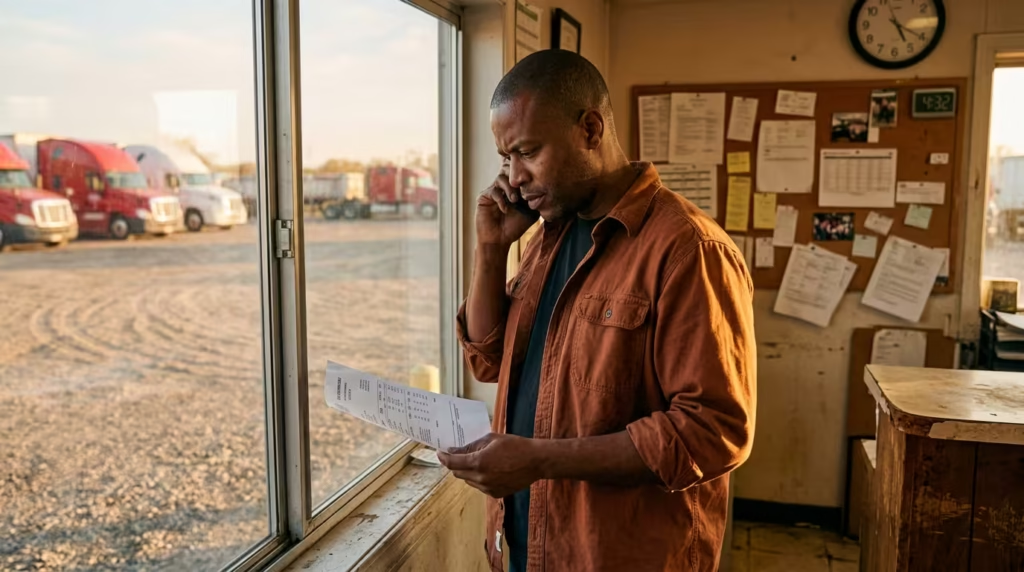
It’s Friday afternoon and one of your trucks needs a load home.
A broker offers exactly what you’ve been looking for. The lane works, pickup is nearby and the rate is better than expected. Your dispatcher has a driver waiting, the clock is moving and accepting quickly keeps the truck productive.
Everything seems to line up. And that’s exactly the moment when slowing down for a few minutes can matter.
Freight fraud has become far more sophisticated than an obviously suspicious email or a broker nobody has heard of. Fraudsters can:
- Impersonate legitimate carriers and brokers.
- Use real USDOT or MC information that doesn’t belong to them.
- Create convincing email addresses and documents.
- Place themselves between legitimate parties who have no idea they’re dealing with an impostor.
FMCSA specifically warns carriers and brokers about fraud and identity theft. That includes unauthorized use of USDOT numbers and people acting as brokers without proper registration. The agency’s fraud alerts also show how convincing impersonation and phishing attempts have become.
For a fleet, that changes the role of dispatch. Moving the truck still matters. But knowing who you’re doing business with matters just as much.
A Legitimate MC Number Doesn’t Tell You Who Sent the Email
Imagine the broker from our Friday afternoon load provides an MC number. Your dispatcher checks it and finds a real company.
Problem solved? Not necessarily. The company may be legitimate while the person contacting you isn’t.
That’s one of the uncomfortable realities of identity-based freight fraud. Someone can use an established business’s information to make a fraudulent transaction look credible. Finding the company in a database doesn’t confirm that the person offering the load actually represents it.
Verify the Contact, Not Just the Company
This is why verification needs to go one step further. FMCSA recommends a few simple checks:
- Compare broker and carrier phone numbers with the information available through SAFER.
- If the contact details don’t match the record, call the company at the verified number to discuss the load.
- Don’t treat a quick Google search as confirmation, since search results can contain fake profiles.
That extra call may feel inconvenient when a driver is waiting. Still, it’s far less inconvenient than discovering after delivery that the company you thought you were dealing with was never part of the transaction.
Double Brokering Can Put Legitimate Companies on Both Sides of the Problem
Double brokering adds another layer, because not everyone involved necessarily knows something is wrong.
How a Typical Double Brokering Scheme Works
FMCSA describes a common scenario that unfolds in a few steps:
- A motor carrier accepts a load from a broker.
- It transfers that load to another carrier without the original broker or shipper knowing.
- The second carrier delivers the freight.
- Then, the original broker pays the party it contracted with.
- The carrier that actually moved the load discovers the intermediary isn’t paying them.
Suddenly, the legitimate broker believes it has paid for the shipment. Meanwhile, the legitimate carrier believes it is owed money. Both can be victims of the same scheme.
For dispatch teams, this is why certain inconsistencies deserve attention instead of easy explanations. Watch who owns the load, who is paying for it and who the driver is supposed to represent.
Red Flags That Should Stop the Transaction
FMCSA identifies some particularly serious warning signs. The agency recommends stopping the transaction and investigating further when:
- Someone asks your driver to present themselves as working for a different carrier.
- The destination suddenly becomes questionable and gets explained away as a “blind load.”
- An unusually high rate is offered with very little negotiation.
None of those signs proves freight fraud by itself in every situation. They do mean the load deserves another look.
Good Dispatchers Learn What “Normal” Looks Like
Fraud detection isn’t about becoming suspicious of every broker. It’s about knowing the operation well enough to notice when something doesn’t fit.
A dispatcher who talks with brokers every day begins to understand what ordinary transactions look like. They recognize familiar domains and contacts. Over time, they learn which rates make sense for their lanes. They also know what normally appears on a rate confirmation and how established partners communicate changes.
That context is valuable because freight fraud often shows up first as a small inconsistency, such as:
- An email domain that’s slightly different from the one used on previous loads.
- A phone number that doesn’t match the company’s public record.
- A rate confirmation that conflicts with what was discussed.
- Unexpected changes to payment instructions.
- Unusual pressure to move the load before questions get answered.
A rushed dispatcher sees another problem standing between the truck and the road. A careful dispatcher sees a reason to verify. That difference can protect far more than one rate.
Verification Has to Become Part of the Workflow
If broker verification only happens when someone already feels suspicious, the process is fragile.
People get busy. Trucks need loads. Familiar company names create confidence, and after hundreds of ordinary transactions it’s easy to assume the next one will be ordinary too.
The stronger approach is to build verification into how your team handles loads. That doesn’t mean turning every booking into an investigation. It means defining two things in advance:
- What your team checks before trusting a new relationship.
- Which circumstances require additional verification.
FMCSA’s own prevention guidance emphasizes confirming contact information and examining documents carefully. It also reminds carriers that even insurance certificates can be fraudulent.
Technology can help. Many fleets use load boards, carrier-monitoring tools and internal records to evaluate the companies they work with. But tools work best when someone is paying attention to what they’re telling you. The dispatcher remains the person connecting the data to the actual conversation.
If you’re weighing how to staff that role, our comparison of in-house vs. outsourced dispatch covers the trade-offs. You may also find our guide on DOT compliance for dispatchers useful.
The Team Protecting Your Time Can Help Stop Freight Fraud
This is one reason dispatch capacity matters beyond simply keeping trucks moving.
Picture one person negotiating loads, answering drivers, tracking shipments, sending broker updates and handling paperwork at once. For that person, verification can start to feel like another task competing for time. And freight fraud thrives on urgency.
A properly supported dispatch operation has more room to follow procedures consistently. It doesn’t have to cut corners because five other things need attention.
At Next Wave, we help trucking companies build dedicated dispatch, tracking and back-office teams in Colombia. These teams work within the carrier’s existing operation. That can mean adding a dispatcher to support a growing fleet. It can also mean moving routine tracking and admin work away from an overloaded internal dispatcher. Learn more about our truck dispatch services.
The carrier still sets its broker-approval procedures, security policies and risk requirements. No staffing partner or dispatcher can guarantee that a fleet will never run into fraud.
What a strong team can do is give the people handling loads the time, training and processes to notice when something deserves a second look.
Sometimes the Best Load Is the One You Don’t Take
The pressure to keep trucks moving is real. An empty truck isn’t generating revenue, drivers don’t want to wait and a good-looking load can disappear while you’re still asking questions.
But speed only helps when the transaction on the other side is legitimate.
Checking an unfamiliar broker, confirming a phone number or questioning an inconsistency takes a few minutes. It can seem inefficient right up until the moment it prevents a much larger problem.
That’s why freight fraud isn’t only a security issue for management to think about after something goes wrong. It’s an operational issue, and dispatch is one of the places where prevention happens every day.
At Next Wave, we help fleets build the dispatch capacity to keep freight moving without rushing through verification. Talk to our team about the support your operation needs.
Because a good dispatch team doesn’t just ask, “Can we cover this load?” Sometimes the more important question is, “Do we know who we’re really doing business with?”
